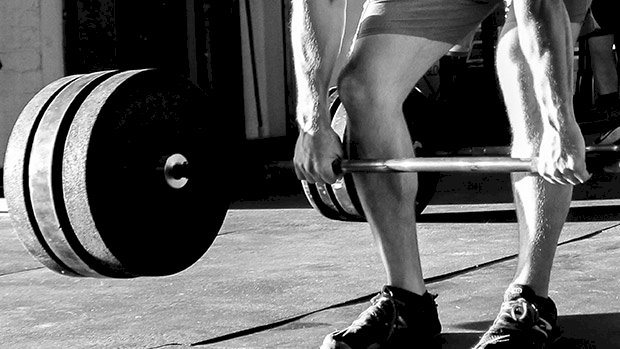
 Mobility matters. As many experienced lifters have learned, mobility restrictions have harmful repercussions when neglected. But remember when “functional training” began to take off? What started off as a good thing quickly became a circus act. Unfortunately, a similar trend is emerging alongside the rise of mobility training. It’s getting a bit goofy. Your goals are probably simple: you want to build muscle, lose fat, get stronger, improve performance, and feel better. Unless you’re trying to become a yoga instructor or make it as a contortionist, you aren’t going to the gym with the sole intent of moving like Gumby. Within the context of training and performance, the only “mobility” that matters is that which has a direct transfer to what you do in the gym, on the field, or throughout daily life. If your mobility enables you to move well and stay healthy while getting stronger, it doesn’t matter if you can touch your toes or do the splits. Stretching and mobility drills have their place, but there’s more to it. The reality is, if you want to improve your mobility and overall function, strength training reigns supreme. Without it, any transient changes that coincide with other modalities won’t “stick.” Let’s Look at the Facts Strength training is superior to static stretching for improving mobility and flexibility. Don’t fall for the antiquated notion that strength training will make you stiff. The research is clear: stretching is not superior to lifting in terms of improving mobility and flexibility. A plethora of studies show that lifting heavy loads through a full range of motion (ROM) is more effective than any other modality for increasing “functional” ROM in the hips, shoulders, hamstrings, ankles, lats, pecs, etc. One study compared the effects of strength training to static stretching in relation to mobility/flexibility in the hamstrings, hips, shoulders, and knees. The researchers concluded that lifting exercises performed through a full range of motion “can improve flexibility as well as, or better than, typical static stretching regimens.” (1) Another study conducted on a group of elite judo athletes looked at the effects of a 12-week strength training program on ROM. It concluded that lifting weights led to significant improvements in mobility/flexibility at the shoulders, trunk, and hips. (2) Greek researchers looked at a group of men who trained with loads at 40, 60, or 80% of their 1RM or one-rep max. The results showed that higher intensities were linked with greater improvements in mobility/flexibility. That is, the men who trained at 80% of their 1RM were the ones who saw the greatest improvements. (3) Strength training improves your ability to stabilize and control newfound mobility. A dead man can do the splits. Flexibility isn’t a physical limitation; it’s a neuromuscular state that helps limit your movement to prevent injury. The feeling of being “tight” when you stretch doesn’t necessarily mean you need to work on your flexibility. In reality, the “tightness” is a byproduct of your nervous system interpreting the stretch as a potential injury, thus shutting the muscle down. When you perform loaded exercises through a full ROM with a controlled eccentric descent (the “negative”), you’re getting a functional stretch within a stable position. At the bottom of a squat, for example, the muscles of the lower body are lengthened to their most optimal position while tension is maintained. Unlike static stretching, which is often performed with shoddy technique and compensatory movement patterns, a loaded exercise forces you to control the entire movement without exceeding your body’s natural range of motion. When you increase passive flexibility via stretching without being able to stabilize or control that extra ROM, you’re risking instability at the joints and increasing your likelihood of injury. If a lack of mobility is problematic, hypermobility paired with instability is catastrophic. Individuals with hypermobile joints are better off taking a jackhammer to their knees than they are getting under a heavy bar. Strength training, especially when performed with an eccentric focus, allows your body to find the ideal balance of stiffness, stability, and mobility. Strength training increases muscle length. Stretching doesn’t. The mechanisms that improve mobility and flexibility as a result of strength training are vastly different than they are for stretching. The notion that stretching increases a muscle’s length is completely false. Stretching is akin to pulling on a rubber band. Sure, it lengthens when you apply tension, but it returns to its normal length when you let go. During a stretch, temporary improvements in flexibility occur primarily due to an increased stretch tolerance and a decreased pain signal associated with reaching a specific muscle length. It’s a neurological process. Nothing within the structure of the muscle actually changes. You’re simply able to stretch
Origin: Stop Stretching, Start Lifting
Stop Stretching, Start Lifting

Published
 All about sport xlsport.club