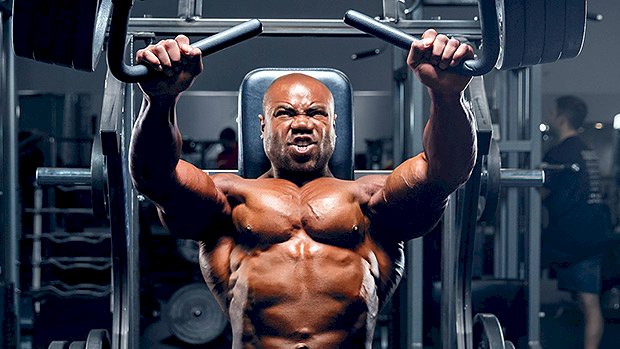
 I Used to be Anti-Machine Like many people who came to lifting heavy objects via the sports of weightlifting and powerlifting, I viewed machines with contempt. I believed people who used them lacked the intestinal fortitude to learn how to use free weights (which are “obviously” superior). Thankfully, I’ve managed to evolve to a less ideological viewpoint, opting for one that’s more evidence-based instead. I ask myself a simple question: “What’s the best way to get big and strong?” Answering this question allows me to be much more open and objective to considering any and all rational methods that take me from point A to point B. I care about the result, not how you get the result. And that’s what allowed me to view machine training in an altogether different light. An Evidence-Based Discussion Current scientific thinking suggests that muscles get bigger and stronger when they’re exposed to unaccustomed levels of tension. The magnitude of that tension is most important for strength goals, and the volume of that tension – the number of times your muscles experience tension per unit of time – matters most for hypertrophy (size) development. Both machine and free weight exercises expose your muscles to tension, but with slightly different pros and cons. So abandon your ideological thinking and think of both options simply as tools that have varying degrees of utility, depending on context and circumstances. And remember, you’re not restricted to one or the other. Machines and Free Weights: The Key Differences By definition, a machine-based exercise is a movement where you’re required to exert force against a resistance without needing to do much in the way of controlling that force, at least compared to similar free-weight exercises. Let’s examine two very similar exercises – the Smith machine squat and the barbell squat. They both stimulate the same muscles, but in slightly different ways. Let’s examine the pros and cons… Advantages of the Smith Machine Squat More technique options. Because the bar slides up and down a fixed rail, you can do a number of things you can’t do with a barbell, like placing your feet in front of (instead of directly under) the bar. This strategy allows you to assume a more upright position than you could achieve with a barbell squat, which means greater quadriceps recruitment. You can use more weight because you don’t need to balance or stabilize. This results in more muscular tension, which in turn equates to more pronounced strength and hypertrophy adaptations. The Smith machine is much more forgiving of relatively minor errors such as positioning yourself slightly off-center under the bar. Disadvantages of the Smith Machine Squat It doesn’t require you to control bar path. While this is the most often-cited criticism of machine training, I’ve never once – in my many years of studying motor unit recruitment – come across the notion that control was a necessary or even a desirable precondition for strength or muscle development. Again, muscle fibers adapt and grow when they’re forced to generate high levels of tension. Not only do Smith and barbell squats both afford the ability to provide this tension, in many cases, the Smith squat is a better way to provide this tension. If you only squat on a Smith machine, you’ll never learn how to do a proper barbell squat. While undeniably true, I wonder how consequential this really is, assuming that you don’t plan to compete in powerlifting. It’s much like pointing out that if you only play the piano, you’ll never learn to properly play the organ. If the goal is organ mastery, this is a problem. But if the goal is to cultivate more generalized musical skills, it’s not. The strength acquired by using free weight exercises has greater positive transfer to many “real world” skills. While we’re now at least getting into a more plausible defense of free weights, the concept of transfer is often poorly understood and applied, largely because movement structure is only one component of transfer. Now, don’t get me wrong, movement structure certainly matters. For example, it’s intuitively obvious that the strength gained from squatting will positively transfer better to a vertical jump than the strength you’d acquire doing leg extensions, mostly because the structure of a squat is much more similar to a jump than the structure of a leg extension. However, if you’re comparing the positive transfer potentials of Smith and barbell squats, there’s really not a whole lot of difference between the two, unless you place your feet considerably in front of the bar when Smith squatting. But even here, the differences are relatively minor. But does needing to control your muscular efforts during a barbell squat transfer over? While there might be something to this, unless you find the vertical jump to be a complex maneuver (in terms of balance and/or overall body control), I’m far from convinced that barbell squatting would offer a
Origin: Why You’re Wrong About Machine Training
Why You’re Wrong About Machine Training

Published
 All about sport xlsport.club