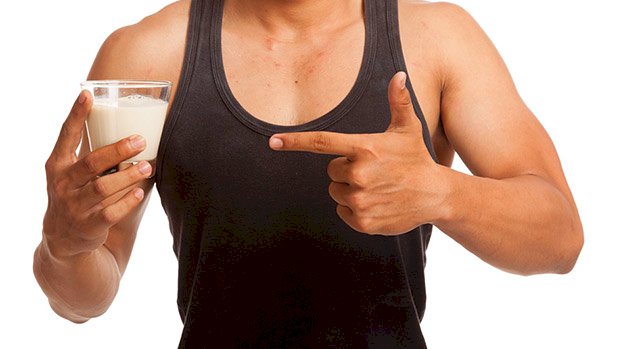
 Back in 1999, I got an email from someone who said he was a scientist that worked for Archer Daniels Midland, the giant global food-processing corporation whose mission it is to sprinkle the world knee deep in soybeans. He wrote to tell me about how some of his research had shown that soy contained chemicals that acted like estrogen and could affect the reproductive systems of human males, thereby reducing sperm counts and reducing testosterone levels. As is commonly done by evil corporations everywhere, Archer Daniels Midland squelched the research. Whether he really worked at the conglomerate and whether ADM really did suppress his research, I don’t know, but regardless, he wasn’t the first scientist to report that soy had negative effects on mammalian reproductive systems. Prompted by his email, I wrote Bad Protein, probably one of the first mass market articles to talk about any possible adverse effects to men from eating soy. Since then, as you’d expect, the bodybuilding subculture, along with bio-hackers, nutritional chemists, and enlightened nutritionists, have long debated the health effects of soy, especially soy protein. Most of the former are at least suspicious, if not downright terrified, of soy, while most of the lay public, thanks in large part to the marketing strength of ADM and other companies in the soybean business, continues to regard all-things-soy as synonymous with health. But it’s been almost 20 years since I wrote that groundbreaking article and a lot of the people who used to condemn soy have forgotten what it was about the grain that got everyone so lathered up in the first place. In fact, most modern-day articles don’t even mention the possibility of an association between soy and male reproductive health. So is soy still “bad protein”? It’s time to take another look at it and see if it deserves a second chance. Someone’s In My Parking Spot The concern with soy is that it contains plant chemicals known as isoflavones that function as endocrine disrupters. These isoflavones are genistein, daidzein, and glycetein. There’s also a fourth – equol – but it doesn’t occur naturally in soy; instead, it’s a particularly potent metabolite of daidzein that only shows up in 33 to 50% of humans who possess the particular bacterial strain necessary for its conversion (1). These isoflavones can affect mammalian cells in two ways. They can either bind to high-affinity, highly specific cell receptors in the cell nucleus, which in turn attach to DNA that leads to protein transcription. In effect, they act just like estrogen, albeit a weaker version. Alternately, they can simply bind to these receptor sites and sit there, preventing real estrogen from getting its normal “parking spot,” thereby preventing it from initiating protein transcription. You don’t want the first scenario to happen, particularly if you’re a male. At least that’s the theory. The thinking is that estrogen, or something that acts just like a weaker version, can be responsible for a host of “feminizing” effects. It can also make it harder to put on muscle. Of course, if you’re a male who has high levels of estrogen in the first place, you wouldn’t mind if any of these isoflavones stole estrogen’s parking spot because they’re weaker than real estrogen. The isoflavone would prevent the real, stronger, estrogen from binding and initiating protein transcription and you’d miss out on possible side effects like additional body fat, gynecomastia, possible BPH, and reduced sperm counts and testosterone levels. If, however, you have a low level of estrogen in the first place, the comparatively anemic activity of the weak estrogen could nevertheless lead to some of this undesirable estrogenic activity. Does It Really Feminize You? What’s the Research Show? We’ve known that isoflavones can cause reproductive disturbances in mammals since 1946 when it was discovered that sheep that grazed on red clover (which is high in phyto, or plant, estrogens) were infertile. Scientists made a similar observation about 20 years later when cows that were stall-fed red clover were also found to be infertile. Soon after, captive cheetahs on a soy-based diet turned out to have the same problem. Fertility was restored in all three cases when the isoflavone intake was reduced. There have also been innumerable experiments on mice and rats, most if not all showing that dietary isoflavones led to reduced fertility, reduced sperm counts, and reduced testosterone levels. Granted, most of these studies involved amounts of genistein that were probably five times more than a human would get through food, but they need to be taken seriously because, as Heather Patisaul, a soy researcher at North Carolina State University, explains, “Our reproductive system and the rat reproductive system aren’t that different. The same hormones are involved.” Some of the human studies showed similar problems. In one study of 99 men, the men who’d eaten the most soy in the
Origin: Does Soy and Soy Protein Feminize You?
Does Soy and Soy Protein Feminize You?

Published
 All about sport xlsport.club