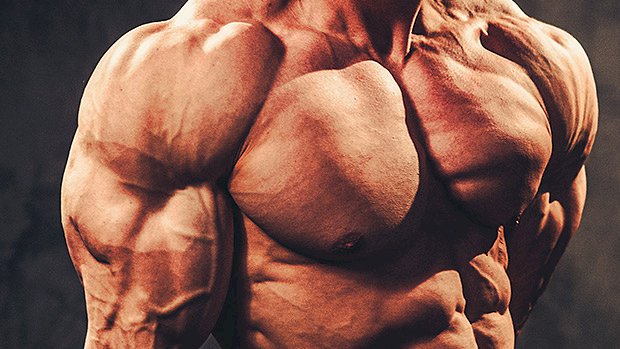
 Delts Turn Heads You’re already training your shoulders, so why not maximize your efforts, stretch out T-shirts, and force people to walk around you? This is the effect of 3D delts and it’ll catch attention like nothing else. But it’s not just for the guys. Ladies, defined shoulders scream athleticism and create an incredible contrast with your smaller waist. The Problem You won’t build shoulders that stand out with just a single heavy set of dumbbell presses. Not even if that one heavy set is at the top of a four-set pyramid. Not even if you crack off an array of isolation exercises afterwards. Why? Because big shoulders are built from big mechanical stress and big volume. The tension required for impressive delts has to come from big compound movements. And when it comes to shoulders, none are bigger than barbell pressing. That’s where the seated overhead press comes in. Why the Seated Overhead Press? It’s my go-to movement for serious shoulder overload and volume. And it should be yours too. So why seated versus standing? Sure, the standing overhead press is a time-tested strength and muscle building movement, but seated optimizes shoulder growth by removing leg drive. Think about it. If you’re standing with a barbell doing overhead presses and you start to fatigue, you’re going to want to dip at the knees a bit and pop that weight up with a little help from your lower body. This is great for explosive power and overall strength, and honestly, not a half-bad muscle builder. But for targeted shoulder tension, leg drive is a cheat to generate momentum and to allow you to use heavier weight than you’d be able to control without the drive. And with seated presses you’ll avoid fatiguing other structures first, allowing you to push delt fibers to near failure, a critical part of muscle-building stimulus. You’ll also reduce lower back fatigue which may limit your work during the training session, and potentially affect your ability to maximize other low back fatiguing movements elsewhere in the program. (Think deadlift and squat patterns.) You want to maximize overall training efforts, not just a single exercise. Now, the seated overhead press SEEMS simple enough, yet people still hurt themselves doing it… or they just get lackluster results. So let’s cover the important parts of maximizing this lift for muscle growth. How To Maximize the Seated Overhead Press 1 – Use a 75-80 degree bench angle. Skip the little 90 degree L-bench. Unless you have great mobility and strict form, you usually end up arched aggressively with shoulder blades sitting on top of the bench. Granted, plenty of guys do an incline bench press with poor lower back support, defeating the purpose of sitting versus standing. But a slight incline allows you to press at a shoulder-friendly angle. Try this: Raise your arms upward straight in front of you until they’re overhead. Are you able to raise them perfectly vertical without arching your lower back? If not you probably can’t do a strict standing press without arching your back beyond what’s natural. Many of us don’t possess the thoracic mobility to get into this position, so we’ll create the arch through our lumbar spine. Not good. Avoid stressing the lower back needlessly, or worse, explosively blasting the humerus into its shoulder socket repeatedly until the rotator cuff tendons shred into pulled pork. Avoid that scenario by building bulletproof shoulders and using a bit of an incline for your heavy overhead pressing. 2 – Use the maximum available range of motion safely available. That means get the barbell under your chin, down to your collarbones if you can. This is going to force you to use a load appropriate to the range of motion. You might be tempted to use a lot of weight, but resist that. Use what you’re capable of pressing with good form. Would you rather pretend to be strong to momentarily impress a couple random strangers at the gym, or train effectively and build actual strength that in time will dwarf the rep done with terrible form? Easy decision. Training through a full range of motion will better stimulate muscle fibers for growth, not only for your delts but also triceps. What’s better than big shoulders? Big arms capped with big shoulders. 3 – Get your grip a little outside shoulder width. Going excessively wide tends to create an excessive arch position with your head in the way. This ends up becoming more of an aggressively-inclined chest press. So to help keep the pecs from taking over, find a grip that feels right for you, allows the best range of motion, and helps you avoid discomfort. Your elbows will flare as you press upwards; this is normal. As you lower the bar, consciously pull your elbows back into their narrow forward-pointed position and repeat each rep. This will allow for comfortable full range of motion and minimal head movement. The bar should travel around your head and you won’t need to move your head out of the way, creating an
Origin: The Ultimate Shoulder Day
The Ultimate Shoulder Day

Published
 All about sport xlsport.club