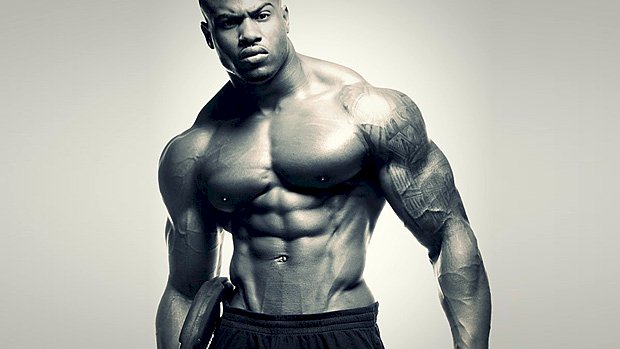
 Here’s what you need to know… Back in the day, bodybuilders were judged on having small waists. And they actually trained using exercises to “tighten” the waist. You can’t narrow the width of the hips, but you can control the width from front-to-back. When Frank Zane was hitting his famous vacuum pose, he was intensely contracting his transverse abdominis or TVA. The TVA runs left to right across your midsection, much like a weight belt. In fact, the TVA acts as a natural weight belt. The TVA also plays a huge role in preventing back pain. To train the TVA, start with the supine vacuum, then progress to the quadruped vacuum, the seated vacuum, and then functional variations. How would you like to shrink your waist by performing one simple exercise? Want to know something that’s even cooler? The same exercise that’s going to decrease your waist circumference is also likely to remedy your lower back pain. The V-Shaped Physique Many lifters today prefer the old-school bodybuilding physiques as opposed to the modern day behemoths. A large part of that preference has to do with the sleek waists possessed by those classic, V-shaped bodybuilders. Back in the 70’s, bodybuilders didn’t just think about building individual body parts; they thought about the appearance of the physique as a whole. That’s what bodybuilding, whether recreational or competitive, should be about – creating a visually appealing physique in its entirety. Even Arnold Schwarzenegger, who was a mass monster in his day, had a really small waist. And when I’m talking small waist, I’m not talking genetically small as in left-to-right (narrow iliac crest or hip width). I’m talking about small front-to-back, which is something that is within your control, unlike your bone structure. Guys like Arnold, Frank Zane, and Lee Haney didn’t just stumble on these tiny waists and the incredible ability to hit a vacuum pose from any angle – they earned them. They actually made it a priority in their training and contest prep to work on performing the coveted vacuum. To them, working on pulling in their midsection was every bit as important as working chest and biceps, and I’d argue that we should have a similar perspective. Science of the Vacuum Exercise Let’s geek out a little bit and look at a little science behind this vacuum-thing. When Zane was hitting his famous vacuum pose, he was intensely contracting a muscle we sadly don’t think much about today, which is the transverse abdominis (aka transversus abdominis), or TVA. The TVA, which lies under the rectus abdominis and obliques, is the deepest of the abdominal muscles. It’s a unique muscle because it doesn’t connect to and move bones closer together like most other muscles. In fact, many of its fibers don’t connect to bone at all. Instead, they run across the midsection, hence the name transverse abdominis. So the TVA runs left to right across your midsection, much like a weight belt. And, in fact, that’s precisely one of the primary functions of the TVA, to act as a natural weight belt. When the TVA contracts, it increases intra-abdominal pressure and stiffens the spine. Again, just like a weight belt. But the TVA isn’t just for use when we’re lifting; it also serves to hold our internal organs up and in our abdomen where they should be. Think of the TVA as the anti-distended-abdomen muscle. And that’s exactly why you need to train it! Sleek and Pain Free A tight midsection isn’t the only reason we’re going to pay attention to the TVA. It also plays a huge role in preventing low back pain. In fact, numerous studies show that most people with low back pain have a “sleepy” TVA – one that doesn’t contract when it should. The good news is that studies also show that your sleepy TVA can be woken up via exercise, and that doing so will quite possibly reduce or eliminate your back pain. Training the Transverse Abdominis It makes sense to start with the easiest, most basic version of the vacuum exercise – or as it’s known in the clinical world, the “abdominal drawing-in maneuver” or ADIM. Given that you’ll get the assistance of gravity, the supine (face up) version is where we’ll begin. Supine Vacuum Start by lying on your back with your hips and knees flexed such that your feet are flat on the floor or bed. Next, exhale as much air as possible. This raises your diaphragm and, much like an empty stomach, allows for maximum contraction of the TVA. Lastly, pull your navel in as close to your spine as possible. The more your navels draws in, the more the TVA is contracting. In the beginning, try to hold the vacuum for about 15 seconds or so on each set. As with any exercise, you’ll want to progress over time. Work up to holding the vacuum for 60 seconds each set. Now, don’t let your inability to hold your breath keep you from doing these longer sets. Take small breaths as needed. Start with three sets and, over time, work up to five sets if you’re serious about getting results. By the way, to
Origin: The Best Exercise for a Smaller Waist
The Best Exercise for a Smaller Waist

Published
 All about sport xlsport.club